Tuesday, October 12, 2010

Holy Land Tour Day 9

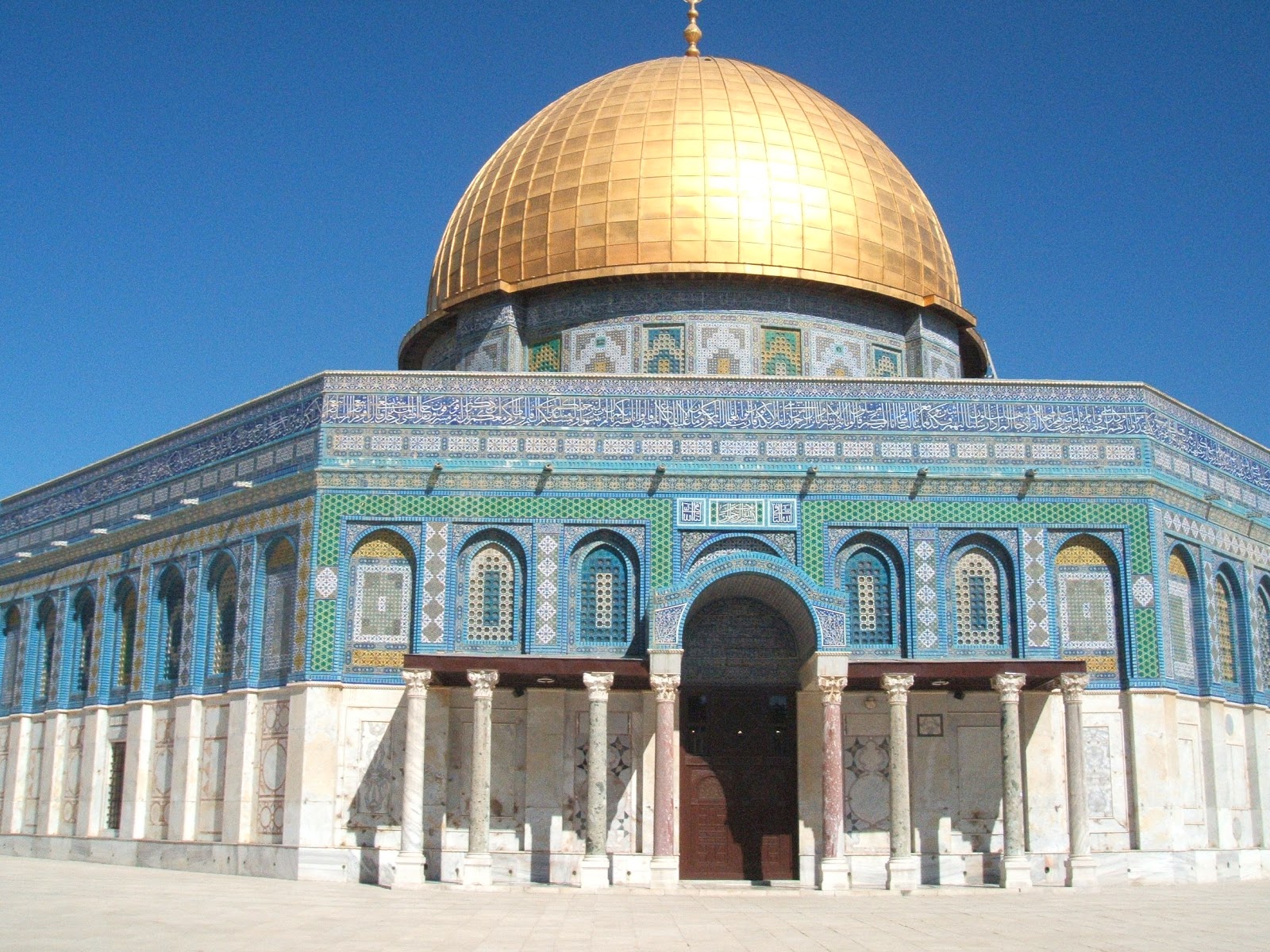
Temple Mount - Dome of the Rock
Still in Jerusalem our second last day. The weather is warm and we have a big day ahead of us in the most sensitive holy place on earth.

After queueing and passing through security we enter the Temple Mount which is controlled by the Muslim community. The  Mosque is out of bounds to non muslims. The massive grounds once housed the first and second Temples of the Jews. All that was ultimately destroyed by the Romans. The muslims have had control of this quarter of the holy city since about the 7th Century. The Dome of the Rock is a monument and not a place of worship. The Dome is clad in gold paid for by King Hussein of Jordan (US$30million) not so long before he died. The magnificent decorated tiles are the work of Armenian artisans. The building was open to non Muslims up until the year 2000 but various tensions have led to the closure. There is an abundant presence of armed soldiers and police who are from the Druze community who are neutral.

At the Western or Wailing Wall
Literally spitting distance away and through more security we enter the Jewish Quarter where the focus is on the Wailing Wall.  Men and women approach in separate sections and we pay our respects and bring our prayers - many people are here doing the same. In the men's section a young boy is making his Bar Mitzvah. We have lots of questions for Gadi about the attire and the rituals being performed at this place.

Next stop is "The burnt house" which is a a.v. presentation set over the actual archeological finding of a house thought to be that of a priest and his family at fall of Jerusalem around 70 AD.
This presentation really brought to life the conditions and the tensions of family and the Jewish community at that time.


Brian and Noella Misquitta outside the synagogue school

Adrian of the geraniums outside the Church at
the place where Peter denied Jesus three times

We had quite a discussion with our guide during the course of this afternoon about current daily life for the more orthodox Jewish people who live in the Jewish Quarter of Jerusalem. This took place outside a boys orthodox school, donated by Baron Rothchild. These primary school aged students learn basically nothing but religious studies.

We walked on to through the Armenian Quarter to the "Cardo" which is the ancient remains of the north south road through Jerusalem along this road was the main market stalls and the central spine of community life.

Moving off Mt Zion, but only just we arrive at the Church called St Peter Gallicante (cock crows). This church is relatively new  but underneath has the ancient remains of a dungeon and tradition has it that Ciaphas' house once stood on this spot and that Jesus was held in the dungeon below.


One thing that is significant about this ancient Holy City is the almost total absence of commercial signage.  Very refreshing.


Great to see our number of followers growing and encourage your comments and if you are a viewer why not join our band of followers. Pilgrims love to hear that their relative or friend is viewing this blog.

Monday, October 11, 2010

Holy Land Tour Day 8

Rest Day in Jerusalem


Somewhere along the Via Dolorosa

The pilgrims make slow progress on our rest day in Jerusalem. Most of us began the day  with a walk to the Church of the Holy Sepulchre and it was great to be there with plenty of space as opposed to last visit with the crowds in the middle of the day. However the queue was ridiculously long to get into the sepulchre itself. So we all abandoned any thought of that.

Instead we explored the ramparts - a number of us walking from the Jaffa Gate to the Dung Gate. Adrian commented that Ray would be in the poo if this did not work out when we got to the Dung Gate !!

Peter spent his day at the Museums, the Lal family did some wheeling and dealing in the market as did Adrian & Helen and Marcia. Helen D managed to get her hair done and Di and Judy discovered King Solomon's mine. Noella took Brian on a catch up visit of the Way of the Cross; Fred and Ranji had a short but successful walk in the surrounds of the hotel. Win expressed concern over some anti Jewish comments being voiced by a Palestinian shopkeeper and Glenys and Ray managed a little bit of artwork.

Pilgrims walking the ramparts of the City Wall - somewhere along the way

We completed the day together no-one was lost and we joined in evening prayers and reflections on the day's activites in prayer room of our Hotel. We all enjoyed yet another sumptious meal.

Thank you for your feedback to this blog which is coming from many quarters around the world. We look forward to more readers joining up as followers and making comments on the blog.

Sunday, October 10, 2010

Holy Land Tour Day 7


Outside St George's Cathedral, Jerusalem
 Sunday morning and the Aussies turn up in force at for the 8am Eucharist in the Cathedral Chapel - they even had to bring in extra chairs to accommodate us!  What a great start to the day.

Well it wasn't really the start because we had all partaken of breakfast before church and we came back to the hotel and had a second helping (well some did!).

Speaking of food our next stop was the  Upper Room where Jesus

partook of the Passover - the Last Supper with his disciples. Almost certainly this is not the room but it is  probably very close to the actual place where the action happened. Close by these days is the tomb of King David which is in marked contrast to many of the religious sites we have seen around the city so far - very simple.

Our next stopover is anything but simple. The magnificent Church of the Dormition of Mary- the tomb of Mary. This Franciscan run romanesque church is literally dripping in mosaics. We enjoyed a good look at its many superb chapels and shrines.

Judy Read & Ken Lal - pensive moment
Winifred Sebire exits the Upper Room


The rest of the day was spent exploring Jewish history. Firstly a visit to the Israel Museum which houses a fantastic and massive  model of Jerusalem in Jesus time - which provides an excellent perspective on the city with its palace, temple, streets and the likely place of Calvary.

This museum also houses the Shrine of the Book - the Dead Sea Scrolls. We will see later in the week where the scrolls were found at Qumran. Our visit to the Museum was to help us view the parchments and the scale of this freak discovery of a Bedouin shepherd boy back in 1947.

Yad Vashem is the Hebrew name for Museum of the Holocaust where we spent a couple of hours. This is an overwhelming presentation depicting man's cruelest hour and the impact that has followed for the people of Israel.  Our guide was clearly quite emotional as he spoke to us about the holocaust.
Our guide, Gadi (centre right) and a more sombre moment at the end of the day.
The pilgrims are enjoying the comments of our followers to this site. We would be delighted if more readers both signed up and added their comments on our journeying.

Holy Land Tour Day 6

Saturday in Jerusalem - The Sabbath

Panorama of Jerusalem from the Mount of Olives
 across the Kidron Valley
 We discover at the outset that here in Jerusalem you get a breakfast comprising only of uncooked items - salad, bread rolls, cereal as it is the Sabbath.

We begin our tour from the Mount of Olives which is a great spot to take in a view of the Old City sitting within the new City of Jerusalem.

We walked down the steep Palm Sunday road to the Garden of Gethsemene. The Garden is simple but well maintained and sits next to a fabulous Church of All Nations.

A short bus ride and we are in the Old City of Jerusalem within the walls and begin to walk the Way of the Cross (Via Dolorosa). The fourteen stations wind their way into the heart of the old city. Our guide tells us he has never seen it so busy. Keeping sixteen head swivelling Australians together is proving to be quite a challenge. Nevertheless we only lost Fred and that wasn't for that long!

A quieter moment on the Via Dolorosa
We enjoyed several terrific stops on the Way of the Cross including St Anne's Church which is renowned for its fabulous acoustics, several groups in the Church at this time just burst into song us included. The Sisters of Zion Convent is built over the water cistern of the old city and we took many slippery steps down to walk on the ancient pathway. It would appear that the present day street level is roughly 3 metres above the level of pavement and buildings in Jesus' time.

The Austrian Hospice is at the corner near Station 4 and a climb to the roof is rewarded with magnificent views of the hustle and bustle of life below.

Another falafel lunch and we are recharged the rest of the Stations, which inevitably become harder to find amid the market stalls along the market streets. Eventually the street becomes an open square with hundreds of people gathered in groups being addressed by their tour guides in various languages before entering the large doorway ahead which is the entry to the Church of the Holy Sepulchre.


Vast crowd in the Church of the Holy Sepulchre
 Chaos is probably the best description of our visit to the place of our Lord's crucifixion and burial. The five Christian denominations that occupy Jerusalem's largest church are all conducting some sort of liturgy or event simultaneously. The Armenian Orthodox seem to be the dominant group and we witnessed the spectacular blessing of various parts of the church in their care. It was  shoulder to shoulder MCG type crowd.

Peter and June who were attempting to capture the very best photographic moment became trapped halfway up a staircase when the thurible carrying deacons ascended the stairs and they did not know where to go - the rest of us were shoved up against the wall or sent packing down the stairs. Nevertheless it was high drama and a great spectacle and another great day in the Holy City.

Saturday, October 9, 2010

Holy Land Tour Day 5


Sunrise over the Sea of Galilee from our hotel room window!
 It was with some degree of reluctance that we moved away today from the Sea of Galilee. It truly is an unbelievably beautiful landscape and is a fresh water sea in the middle of Israel with such significant history. This inland sea provides water for the huge agricultural and farming areas which we seem to travel through endlessly. No farmhouses as workers live in small towns and commute to the farms to work. The market gardens are abundant - mangoes, olives (of course) pomegranites, grapes abound.
We were thrilled to capture sunrise in this way before we checked out of the hotel that morning.


View from Mt Carmel across the valley of Jezreel
 From one spectacular view to another - this time we are on top of Mt Carmel on our way to the coast and the Mediterranean Sea. On this mountain the prophet Elijah challenged 400 prophets of Baal (this was in the time of King Ahab and Queen Jezebel). A Carmelite church  marks the spot and above it a fantastic viewing platform that overlooks the entire area and we can see agriculture happening  for 360 degrees.

On this journey we also visited Megiddo and from a similar high vantage we could overlook the same valley. Megiddo is considered the place of Armageddon in the New Testament that is where the final battle will be staged according to the book of Revelation. The mountain was once a home to a large fortress and going back thousands of years already there have been countless battles for this spot. Archeologists have uncovered layer upon layer of civilization, if that is the right word, in this place. The ruins are enormous and we climbed way down 153 steps into an underground passage way that ancient people would use to collect water from the spring outside the city wall. This tunnel is still very well preserved and safe and thankfully it was 80 steps back up and out to the waiting bus.

Our last blog view for this day is from the heights of Caesarea (not Philippi). This City is a significant Port today and has been going back to Roman times. The Governors of the Province of Judaea had their summer palace in this place. There is even evidence of Pontius Pilate staying here. The ruins on the foreshore of the Mediterranean are extensive and included a massive hippodrome for horse racing, the palace and a Roman theatre - which is still used as a performance place today.


Looking back towards the Port of Caesarea and out to the Mediterranean sea

Our next views  from the bus this afternoon would be looking across at Tel Aviv and then finally as we approach the City of Jerusalem.

Holy Land Tour Day 4

Ray at the ancient shrine Caesarea Philippi
After an earlier start our bus driver, Wasim, takes us north of the Sea of Galilee in fact to the far northern region of Israel. This is the corner where the borders of Israel, Syria and Lebanon converge. The hills around this area have been hard fought battle zones down through the ages and even in recent times.

We are most interested in the ancient shrines of Dan,  Caesarea Philippi and Banias. A strong spring was one of the vital reasons for these settlements in ancient days. The area has an array of fascinating worship sites, castles and the remnants of village life all uncovered by archeologists. The spring is the source of the Jordan River - it is powerful, cool, fresh and we enjoyed walking alongside it for some distance and even saw fish in it. See in the picture ancient carvings in the rock face above Ray's head.


Glenys with Ranji & Fred Benjamin taking a break


After a delicious falafel lunch we visit Chorizim a rocky and desolate place that Jesus threatened to curse because of the lack of welcome he received there.

An impressive ancient synagogue of huge proportions occupies the site along with other  ruined buildings taken down by an earthquake hundreds of years ago- not by Jesus' curse we do believe.

From here we travel a short distance to a church built on a huge rock on the shores of the Sea of Galilee. This is called 'Peter's Primacy" it combines Jesus' commission to Peter "feed my sheep" and the church which straddles a massive rock reminds pilgrims today that Jesus charged Peter to be as solid as a rock and on such a faith the church will grow.

Statue of Jesus commissioning St Peter by the Sea of Galilee


Holy Land Tour Day 3

As you can see from this photograph we began the day with a short drive to Cana and followed a winding lane to what is called the 'Wedding Church' and along the way the odd bottle of produce is being sold!

Then we made a trip to Nazareth and the Church of the Annunciation. This is set in the midst of a predominantly Muslim community and the voice of the Imams echoes across the valley. The Church is spectacular, modern and straddling the old site of supposedly Mary's house. The graphics  and the mosaics are fantastic including one by and for Australia.

Next we visit a Nazareth Village a bit like Sovereign Hill in Ballarat and are taken back 2000 years in time. It provided a good picture of life in Jesus' time including a shepherd at work, a carpenter, a lady spinning wool and weaving etc.   It was a bit weird when the shepherd answered his mobile phone!

Church of the Transfiguration Mt Tabor
Our next stop would be on the top of Mt Tabor and the place of Jesus' Transfiguration where he appeared with Moses and Elijah. But to get there required several taxis to take our pilgrims up the 16 hair-raising hairpin bends to the top. The Church and the view was spectacular and we celebrated the eucharist in an outdoor chapel alongside the church in the picture.

Fred Benjamin had purchased some holy oil and this was blessed and used for anointing after the eucharist. Even our Jewish guide, Gadi, joined us for holy communion.

It was like the disciples, Peter, James and John, for we felt like it was good to be on the mountain and a very special place to celebrate the eucharist together for the first time as a group.

Each night before dinner we are gathering somewhere in the hotel for prayers using the book that Ray and Catherine put together before leaving Melbourne. It has been much appreciated.